We read this paper together in the first class. Every post below was written as an example of what a task can look like, so you can copy its structure (and see how citations, figures, charts and code work on this site).
Why Pretraining Fails to Share Cross-Lingual Knowledge
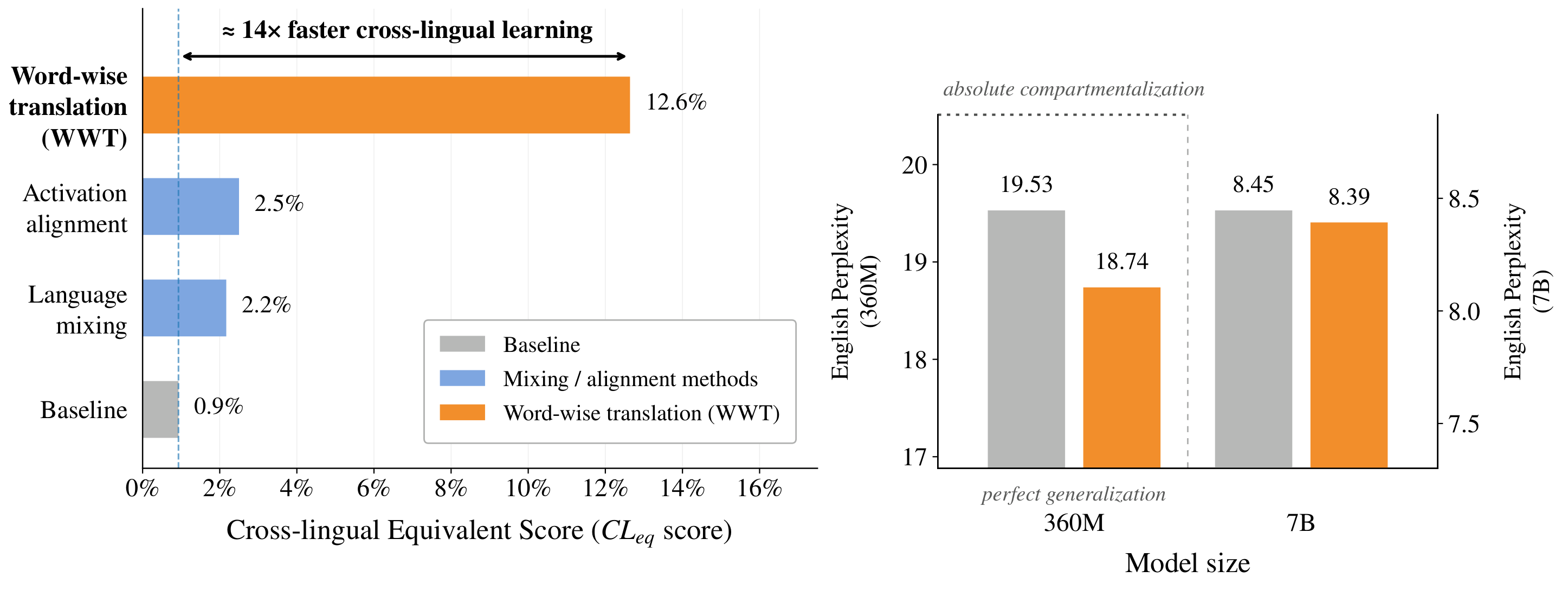
TL;DR Bilingual LLMs learn the same fact twice, once per language, and the cause is largely tokenization: two copies of English with disjoint token IDs already fail to share knowledge. Mapping Arabic words into English tokens (word-wise translation) makes knowledge transfer 14× better.
What the class wrote 11
✍️ Writing
✍️ Writing Oct 16, 2026
Three things to remember, and where the paper hides them
The points most readers should leave with, and how the paper could make them harder to miss.
✍️ Writing Oct 16, 2026
Rewriting the abstract: lead with the surprise
The paper's most striking result is buried in sentence six. Here is a version that starts with it.
🧠 Learning to learn
📊 Visualization
📊 Visualization Oct 16, 2026
The core idea in one picture
Same sentence, same model, different token IDs, and the knowledge stops flowing. A diagram of the three setups.
📊 Visualization Oct 16, 2026
A better Figure 2: the threshold the bar chart hides
The paper's key soft-mapping result is a curve with a cliff. Drawn as bars, the cliff disappears.
📣 Communicate to the world
📣 Communicate to the world Oct 16, 2026
Week 0 in one page: tokens keep knowledge apart
The paper, what we learned, and everything the class wrote about it, in a five-minute read.
📣 Communicate to the world Oct 16, 2026
The paper in four feeds
Posts for X, Bluesky, Mastodon and LinkedIn, and why each one is written differently.
🔬 Research skills
🔬 Research skills Oct 16, 2026
Where this paper comes from: a literature map
The four lines of work it builds on, and the one it argues with.
🔬 Research skills Oct 16, 2026
Five follow-ups worth doing
Concrete next experiments, from a weekend project to a thesis chapter, and why each is worth the time.
🔬 Research skills Oct 16, 2026
Critique: a clean diagnosis, a partial cure
Strengths, weaknesses, what would have made it stronger, and a verdict.
💻 Coding
Who is doing what (week 0)
Who does what in week 0: see the sign-up sheet. Its Week check tab shows what is still missing.
Write about this paper: Write