Reimplementing Figure 1 with additional metrics
Reimplemented Figure 1 and added new metrics to evaluate the model on

What I reimplemented
Figure 1 shows different lm_eval metrics that have been evaluated for this model for different r values. The recurrent value shows how many times does the embeddings pass through the recurrent block to generate the final answer. Therefore, we implemented the graph for 2 of the 3 existing metrics and added 3 metrics of our own. The new added metrics are chosen to be structed, multiple choice questions in realms that are not scientific; which are different than the metrics in Figure 1. The realms are of everyday and language commonsense. In addition, mmlu_humanities deals with philosophy, moral disputes, law, logic, history, religion and such.
The code
I’ll link to my fork of the project’s github code, with the relevant branch of the source code under evaluations/ folder.
Full code: link
Results
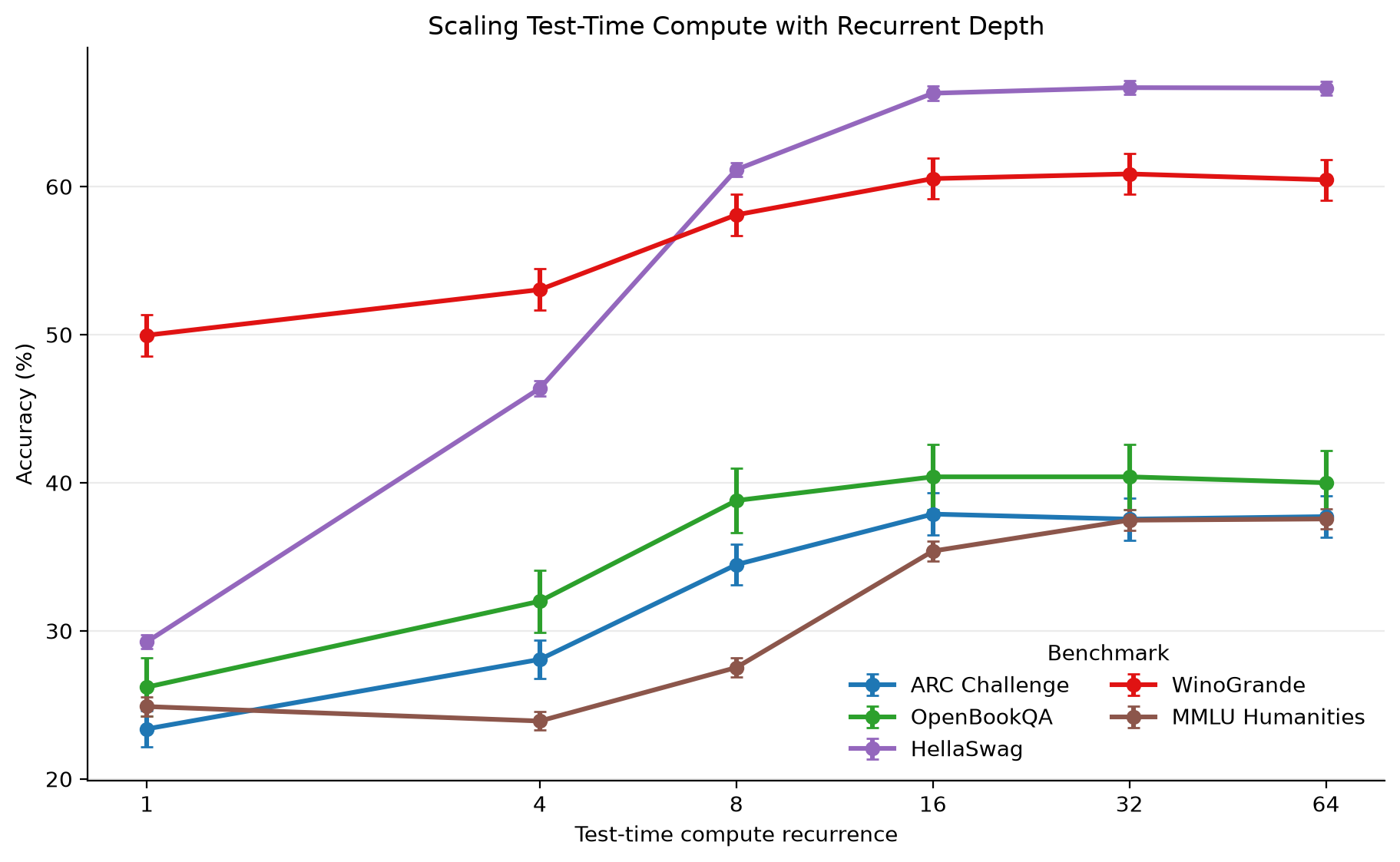
All metrics show a similar trending curve as the one described in Figure 1: The model’s perfromence increases dramatically up to r=16, especcialy from r=4 to r=8 and from r=8 to r=16.
Despite the model’s training data being skewed towards scientific and programming data, the model’s perfromence on humanities are comparable to OpenBookQA. The 2 commonsense evaluations scored relatively high to scientific and humanities evaluations, which is expected by them not requiring specialied knowledge and/or training.
In regards to the 2 metrics that are in the article’s Figure 1 as well, the results are very close but not exactly the same. This might be due to random seed differences (mine was random and the article’s wasn’t specified)
What I learned
The KV cache of generation takes a lot of memory effecting the memory requirements dramatically in varying r ranges. This requires calibrating the evaluations for each metric and for each r values to not crash the evaluations run.
Furthermore, the various other metrics do re-enforce the idea that increasing r does improve results up to a degree; while the results platue without increasing the dataset / model size and such
Enjoy Reading This Article?
Here are some more articles you might like to read next: